Building credit from nothing runs into a specific trap: you cannot get approved for most credit products without a credit history, and you cannot build a credit history without getting approved for something. It is a real loop, and most advice about escaping it is either too vague to act on or skips the part where it takes real time regardless of which path you choose.
What a credit score actually needs first
Before anything else: scoring models require a minimum amount of reported history before they can generate a score at all. FICO generally needs about six months of activity on at least one account. VantageScore, which many free credit-monitoring apps use, can sometimes produce an initial score in as little as a month with less history. Neither of these is a shortcut you can buy — the clock only starts once something is actually reporting to your file, which is why the first move is getting one real account reporting as early as possible, not finding the "best" way to build credit in the abstract.
The fastest option: become an authorized user
If a parent, partner or family member has an older credit card in good standing — on-time payments, reasonably low balance relative to the limit — ask if they will add you as an authorized user. Their account's history, including its age, can appear on your credit file within a billing cycle or two, depending on whether that issuer reports authorized users to the bureaus (most major ones do, but it is worth confirming).
This only helps if the primary account is genuinely well managed. An authorized user inherits the account's history, including any late payments or high utilization, so being added to a poorly managed account can hurt as easily as it helps.
Building entirely on your own: a secured card
A secured credit card is the standard path for someone building independently. You put down a deposit, commonly $200 to $500, which becomes your credit limit. You use the card for small, planned purchases and pay the statement in full each month. The deposit is what makes approval possible without existing credit; the reporting to the bureaus works exactly like a normal unsecured card.
Look for a secured card that explicitly reports to all three bureaus, and check whether the issuer offers an automatic upgrade path to an unsecured card after a period of on-time payments — many do, which returns your deposit once you graduate. Once you're ready to compare unsecured options, see how to choose a credit card.
Credit-builder loans
Offered by many credit unions and some community banks, a credit-builder loan works in reverse of how a normal loan feels. The "loan" amount sits in a locked savings account while you make fixed monthly payments toward it; those payments are what get reported to the bureaus. At the end of the term, you receive the savings, often with a small amount of interest. This is a genuine alternative for someone who does not want a credit card at all, and it builds payment history in a way that is harder to overspend on than a card.
What does not build credit by itself
Rent payments generally are not reported to the credit bureaus by default, since most landlords do not report at all. Rent-reporting services exist that let you opt in, for a fee in many cases, and some newer platforms report automatically if your landlord participates — but it is not automatic just because you pay on time.
Utility and phone bills work similarly. Experian Boost is a legitimate, free service that lets you add certain bill payment history to your Experian file for scoring purposes with some lenders, which is worth doing since there is no real downside, but it does not apply universally across all three bureaus or all lenders.
Debit card use does not build credit at all, regardless of how responsibly you use it, since no debt or credit line is involved for the bureaus to track.
Once you have your first account
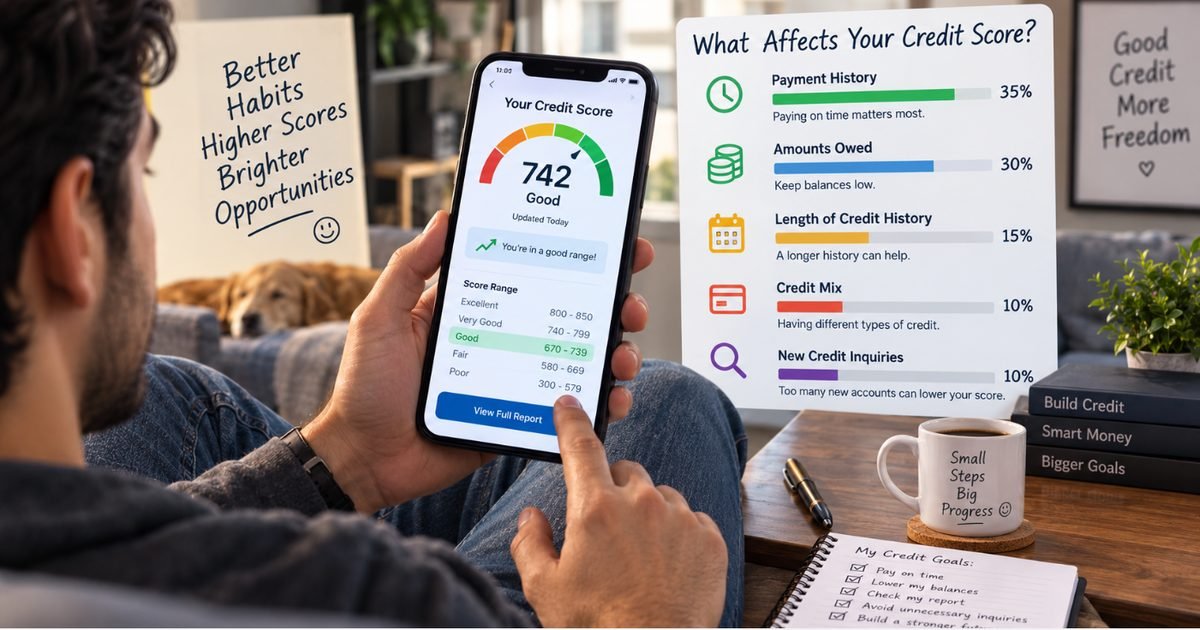
The factors that build a score from there are the same ones that maintain any credit file: paying on time every time, keeping utilization low relative to your (likely low, at first) limit, and letting the account age rather than closing it. See how credit scores work for the full breakdown of what the models weigh, and how to improve your credit score for the order of operations once you have something to improve.
What hurts a thin file specifically
A file with one or two young accounts is more sensitive to certain mistakes than an established file:
- Multiple applications in a short window each add a hard inquiry, and a thin file has fewer other factors to absorb that effect.
- A high balance on a low starting limit moves your utilization percentage fast — spending $150 on a $200 limit is 75% utilization, which is a meaningfully worse signal than the same $150 would be on a $2,000 limit.
- Closing your only or oldest account removes the history you were building and can shorten your average account age right when you need it most.
Patience is the least satisfying answer and the most accurate one: a thin file becomes a normal one mainly through time and consistency, not through finding a clever workaround.
Frequently asked questions
What is the fastest way to build credit from scratch?
Becoming an authorized user on a family member's older, well-managed credit card can appear on your file within a billing cycle or two, making it the fastest single step. A secured card you open yourself is the fastest path that does not depend on someone else's account.
How long does it take to build credit from nothing?
FICO generally needs about six months of reported history on at least one account before it can generate a score. Some apps using VantageScore-based models can produce an initial score in as little as a month. Either way, there is no way to skip the underlying reporting period — only to start it as early as possible.
Can paying rent or bills build my credit?
Not by default. Most landlords and utility companies do not report payment history to the credit bureaus. Services like Experian Boost let you opt in to have certain bill payments counted for some scoring purposes, which can help, but it is not automatic.
Do I need a credit card to build credit?
No, though it is the most common route. Credit-builder loans, offered by many credit unions and community banks, work in reverse — you make payments into a locked savings account, and those payments are what get reported — and are a genuine alternative for someone who wants to avoid a card entirely.
What hurts a thin credit file the most?
Applying for several accounts at once, since each hard inquiry has an outsized effect on a thin file, and carrying a high balance relative to a low starting limit, since utilization is calculated as a percentage and a small starting limit makes that percentage move fast.